

#Short Answer
Artificial intelligence (AI) is increasingly being integrated into emergency and disaster response systems to enhance preparedness, response, recov...
#Infobox
Artificial intelligence is transforming emergency and disaster response through predictive analytics, autonomous systems, and real-time decision support.
#Overview
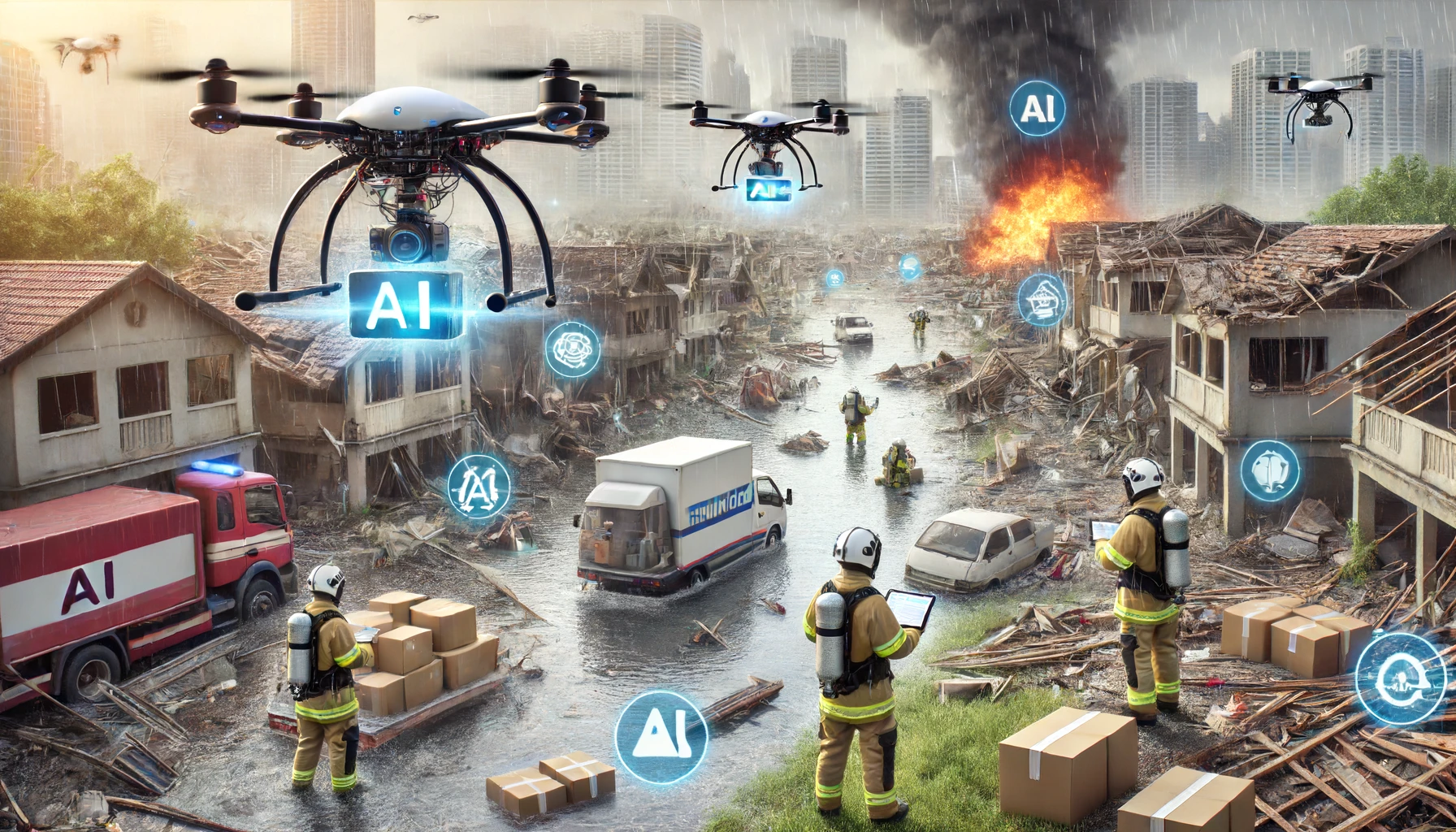
Artificial intelligence (AI) is increasingly being integrated into emergency and disaster response systems to enhance preparedness, response, recovery, and mitigation efforts. AI-driven tools analyze vast datasets from satellites, sensors, social media, and historical records to predict disasters, optimize resource deployment, and support real-time decision-making. These systems range from machine learning models that forecast extreme weather events to autonomous drones that assess damage and locate survivors in hazardous environments.
In emergency management, AI enhances the four phases of emergency management: mitigation, preparedness, response, and recovery. By automating routine tasks and providing actionable insights, AI enables responders to focus on high-priority actions while reducing human exposure to danger. For example, AI-powered chatbots can disseminate evacuation instructions, and computer vision systems can analyze satellite imagery to identify structural damage after earthquakes.
#History / Background
The integration of AI into disaster response began in the early 2010s, coinciding with advancements in big data analytics, cloud computing, and sensor networks. Early applications focused on predictive modeling using historical disaster data and weather patterns. The 2011 Tōhoku earthquake and tsunami in Japan highlighted the need for real-time situational awareness, prompting the development of AI systems capable of processing seismic and tsunami data rapidly.
By the mid-2010s, AI was being used to analyze social media posts during crises, such as the 2013 Boston Marathon bombing, to extract critical information about victims and threats. The rise of deep learning in the late 2010s further accelerated progress, enabling more accurate image recognition and natural language understanding. The COVID-19 pandemic (2020–2022) demonstrated AI’s role in contact tracing, outbreak prediction, and vaccine distribution logistics, reinforcing its value in public health emergencies.
Today, AI is a cornerstone of modern emergency response frameworks, supported by initiatives from governments, NGOs, and private technology firms. International organizations such as the United Nations Office for Disaster Risk Reduction (UNDRR) and the World Health Organization (WHO) now advocate for AI integration in national disaster risk reduction strategies.
#How It Works
#Data Collection and Integration
AI systems in disaster response rely on diverse data sources, including:
- Remote Sensing: Satellites and drones equipped with multispectral and thermal cameras capture real-time imagery of affected areas.
- IoT Sensors: Seismic sensors, flood gauges, and air quality monitors provide continuous environmental data.
- Social Media and Crowdsourcing: Platforms like Twitter and Facebook are mined for geotagged posts, images, and videos shared by the public.
- Historical Records: Past disaster data is used to train predictive models for recurrence patterns.
- Weather and Climate Models: AI integrates meteorological forecasts to predict extreme weather events such as hurricanes, wildfires, and floods.
#AI Technologies and Methods
Several AI techniques are employed in disaster response:
- Machine Learning (ML): Supervised and unsupervised learning models predict disaster likelihood, classify damage severity, and optimize evacuation routes.
- Computer Vision: Deep learning models analyze drone and satellite images to detect collapsed buildings, blocked roads, and fires.
- Natural Language Processing (NLP): AI processes text and speech from emergency calls, social media, and news reports to extract critical information.
- Reinforcement Learning: Used in autonomous systems to improve decision-making in dynamic environments, such as guiding rescue robots.
- Edge Computing: Enables real-time AI processing on devices like drones and smartphones without relying on cloud connectivity, crucial in disrupted networks.
#Operational Applications
AI supports disaster response through:
- Early Warning Systems: AI models analyze seismic, meteorological, and oceanographic data to issue alerts hours or days before a disaster strikes.
- Resource Allocation: AI optimizes the distribution of medical supplies, personnel, and equipment based on predicted impact zones.
- Search and Rescue: Autonomous drones and robots equipped with thermal cameras and AI vision locate survivors in rubble or dense vegetation.
- Damage Assessment: Post-disaster, AI evaluates structural integrity from aerial imagery, prioritizing areas for intervention.
- Communication Networks: AI manages emergency communication systems, rerouting messages when infrastructure is damaged and detecting misinformation.
#Important Facts
- AI can reduce emergency response times by up to 30% in urban areas by optimizing route planning for ambulances and fire trucks.
- During the 2017 Hurricane Harvey response, AI-powered flood prediction models helped evacuate over 30,000 residents in Houston.
- Drones equipped with AI vision have reduced search-and-rescue operation durations from days to hours in wilderness emergencies.
- AI systems can process over 10,000 social media posts per minute during a crisis to identify urgent needs and threats.
- Predictive models using AI have improved wildfire detection accuracy by 40% in regions like California and Australia.
- AI chatbots have been deployed during pandemics to answer 24/7 queries, reducing the burden on healthcare hotlines.
- Robotic systems guided by AI have entered collapsed buildings in Japan and Mexico to locate survivors after earthquakes.
#Related Terms
#FAQ
What does AI And Emergency: Disaster Response cover?
Explores how artificial intelligence shapes emergency and disaster response, covering practical use cases, benefits, limitations, and risks.
Why is AI And Emergency: Disaster Response important?
It helps readers understand key concepts, compare practical use cases, and evaluate how Climate & Society decisions affect outcomes, risks, and implementation choices.
What should readers verify before applying this topic?
Readers should compare the benefits, limitations, data requirements, and related themes such as Emergency, Disaster, Response before using the ideas in real projects.
#References
- AI And Emergency: Disaster Response terminology and background research
- AI And Emergency: Disaster Response use cases, implementation examples, and limitations
- Climate & Society best practices, standards, and risk guidance
- Emergency case studies, benchmarks, and current industry analysis


Comments
No comments yet. Start the discussion with a useful note.